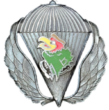

The “Flying Butter Knife” Insignia
The Complete History of the 173rd Airborne Brigade
The 173rd Airborne Brigade—celebrated historically as the “Sky Soldiers”—holds an immutable position in the annals of the United States military. As a vanguard rapid-deployment unit, the brigade’s history is a testament to elite training, immediate strategic responsiveness, and profound battlefield sacrifice.
World War I and World War II Origins
The unit was originally constituted on August 5, 1917, as the 173rd Infantry Brigade, part of the 87th Division. Deployed to France in 1918 as part of the American Expeditionary Forces, the brigade served honorably during the final phases of World War I before being demobilized.
During World War II, the brigade was designated as the 87th Reconnaissance Troop, fighting heroically through three European campaigns. Concurrently, the legendary 503rd Parachute Infantry Regiment (PIR)—which today forms a cornerstone of the 173rd’s fighting strength—made history in the Pacific Theater, executing the first successful combat jump in New Guinea (1943) and a brilliant, hazardous airborne assault to liberate the island fortress of Corregidor in 1945.
Birth of the “Sky Soldiers” and Arrival in Vietnam
On March 26, 1963, the modern era of the unit began when it was activated on the island of Okinawa as the 173rd Airborne Brigade (Separate). Operating as the quick-reaction force for the U.S. Pacific Command, the brigade conducted intense training deployments across the Pacific. It was during joint exercises with Nationalist Chinese paratroopers that the local forces dubbed them “Tien Bien”—translated directly as “Sky Soldiers.”
On May 7, 1965, the 173rd made history by landing at Bien Hoa Airbase, becoming the first major United States Army ground combat unit committed to the Vietnam War. Originally assigned to secure the vital air base complex, the brigade’s role quickly expanded into aggressive offensive operations. At its peak operational strength in theater, the brigade comprised over 7,000 elite paratroopers.
Six Years of Continuous Jungle Warfare
The 173rd became the first American unit to push deep into the dense, heavily fortified enemy sanctuaries of War Zone D and the Iron Triangle. They pioneered new tactical methods for jungle counter-insurgency, including the introduction of small, independent Long Range Reconnaissance Patrols (LRRPs) to scout deep behind enemy operational lines.
On February 22, 1967, during Operation Junction City, the 173rd secured another historic milestone. Nearly 1,000 Sky Soldiers dropped from C-130 Hercules transport aircraft into a tight jungle clearing in Tay Ninh Province, executing the only major combat parachute assault of the entire Vietnam War. The airborne assault successfully formed a surprise blocking force that decimated heavily dug-in Viet Cong forces.
The Bloodiest Engagements: The Battle of Dak To
In the summer and fall of 1967, the 173rd was thrust into the Central Highlands to block North Vietnamese Army (NVA) divisions from carving South Vietnam in two. This culminated in the brutal Battle of Dak To in November 1967. Over 96 hours of relentless, close-quarters infantry fighting, the Sky Soldiers assaulted and successfully captured the heavily fortified Hill 875.
The victory dismantled the NVA 174th Regiment but came at an immense physical cost. For their extraordinary collective gallantry in the Central Highlands, the entire brigade was awarded the Presidential Unit Citation.
By the time the brigade cased its colors and departed Vietnam in August 1971, it had spent more than six consecutive years in active combat—longer than almost any other American unit in history. Sky Soldiers in Vietnam earned 13 Medals of Honor, 46 Distinguished Service Crosses, and 1,736 Silver Stars. A total of 1,647 brigade warriors made the ultimate sacrifice, with more than 8,400 wounded in action.
Reactivation and Global Strategic Response
After being deactivated in 1972, the 173rd Airborne Brigade was triumphantly reactivated on June 12, 2000, in Vicenza, Italy. It assumed a critical modern role as the European Command’s strategic conventional airborne rapid-response force.
The brigade was quickly called back to the front lines following the events of September 11. On March 26, 2003, the 173rd added another legendary chapter to its airborne history when approximately 1,000 Sky Soldiers conducted a massive night combat jump into northern Iraq during Operation Northern Delay, successfully opening a vital northern front in the Iraq War.
Following their deployment in Iraq, the brigade executed four grueling combat tours in Afghanistan (2005, 2007, 2009, and 2012) in support of Operation Enduring Freedom. Operating in the jagged mountains along the Pakistan border, elements of the brigade engaged in some of the most severe infantry firefights of the Global War on Terrorism, including the famous Battle of Wanat, earning an additional 33 Silver Stars, a Distinguished Service Cross, and a Medal of Honor.
The Heritage Today
Today, operating out of Italy and Germany, the 173rd Airborne regularly conducts complex multinational airborne training operations alongside NATO allies across Europe. Moving into the future, the unit maintains its strict paratrooper traditions, standing ready to deploy anywhere in the world at a moment’s notice, carrying forward the unbroken legacy of valor forged by generations of Sky Soldiers.